While our welder has been working on joining all the front wheel support tubes, I turned my attention to the supports that will hold the front wheel differential in place. I last worked on these back in January. The original idea was to make a bunch of aluminum plates and weld them together. But then we started having some trouble welding the aluminum tubes. Since I had the time and I had started to think maybe we shouldn't try to weld everything, I decided to design a weldless version of the support. Yes. I altered the plan further.

The new, NEW design
The old, new design

Instead of using ball bearings, I decided to reuse the original bronze bushings that came with the differential. They are much smaller so they don't need as much material to hold them. I first made a bed with caps to hold the bushings, but that turned out to be too hard to fabricate. The inside edges of the bushing pockets cannot be cut square, so I would never be able to finish making this part as designed.


Our machine shop captain suggested just making blocks and pressing the bushings into them. Then I could just bolt the blocks to a plate and bolt the plate to a support. That simplified things even more. 


Now I "just" have to make the parts. I already finished one of the plates.


I tried to make the support brackets last weekend, but I had trouble with the CAM operations I programmed. The cutting operations IRL were a lot deeper than the virtual ones seemed and I ended up breaking my end mill bit. End mills are not cheap. The worst sound in the world is the cutting going from a high pitch hum of a good cut to the low frequency drone of a bad cut.

I will revisit that next weekend. In the meantime, I will make the bushing blocks on the CNC mill. These parts are simpler so the CNC operations are simpler. 

We'll see what happens. 🤞


Rudy May 31, 2023
Read more

I've been vacillating on the design of the knuckles that support the front wheel axles for a while now. First, it was a series of flat aluminum plates that would be welded together into a bracket. Then, I redesigned it to use rectangular tubing to avoid having to weld plates together. I knew I'd have to machine all 4 sides of the rectangle, but it seemed easier than the first scheme. I was confident enough that I ran some stress analysis on the rectangular bracket. Everything seemed doable. 

But as we've gotten closer to actually making these parts I've changed my mind again. The way it was designed, the parts would require both CAM (computer-aided machining) and considerable manual machining to complete, including a lot of tricky alignments between the faces. Making the knuckles suddenly seemed harder than I originally thought. So I altered the plan one more time.

Instead of making it out of rectangular tubing, I went back to the idea of multiple pieces but with a twist. The piece that holds the wheel axle is again a flat plate, but, instead of welding, it will be bolted to two brackets.


The brackets are thicker than the plates that preceded them, so they can better support the forces going through them without needing an inside wall. I also added ledges to the brackets to reduce the forces going through the bolts that hold the face plate in place. And I designed them so 90% of the machining can be done by computer. I still have to drill and tap mounting holes on each of the brackets, but that should be easy to do manually after the CAM jobs are complete.

So yes, it still requires both automated and manual machining, but I think it's much less work to complete than before.

It took all day Sunday and Monday evening, but I was able to run the CAM jobs on the Tormach with the help and supervision of our machine shop Captain. The parts came out great and now they are made, so I can't alter this any further. 


I just have the manual bits to complete. I have to flip the plates over and remove the extra material in a facing operation (looks like the plates are in Carbonite! 🤣) and I have to drill and thread mounting holes on the brackets.

Rudy May 10, 2023
Read more

We started making parts! After months of designing, planning, analyzing, sourcing parts and buying materials, we finally started making parts. The front end wheel supports are involved, so we started there. The front structure has multiple tubes at multiple angles that all have to fit together as snugly as possible. Most of the sculpture and pilots' weight will be supported by these tubes, so getting them right is critical.


To make it harder, the cuts on either side of each tube are perpendicular to each other. There's even one tube that has cuts in two different directions on the same side. I always say, "You're only as good as your tools," and this was no different. There's no way I could do this without specialized tools.

I had already bought a tube notcher that would allow me to cut the 30° and 60° notches that I needed, and 1-1/2" and 2-1/4" hole saws. I already owned a digital angle finder that I could use to set angles accurately on the tube notcher. To align the two ends correctly, I'd get to use my newest tool--a digital level.

I started with the front two tubes, since they had the most occurences of the same cut. I set the notcher at 90° using the digital angle finder and cut the large arcs.

Then I taped 2-1/4" tube pieces snugly into the notches, so I could balance the digital level on it (Thanks to our machine shop captain for the great tip). The other side of these tubes needed 1-1/2" notches that were perpendicular to the first cuts. After I measured the angle of the drill shaft, I rotated the "T" until it was 90° to the drill shaft and cut the outside notches.

Aligning the tube to finish the long notch on the lower, rear tube

Cutting a 1-1/2" notch 

I repeated the steps until all the profiles were cut. It took several hours over some weeknights and a weekend.
 
Fit check - lower tubes

I would have been done sooner, but I screwed up the 60° cut on the lower rear tube. I convinced myself the alignment was correct, but it actually was backwards. And that's how it goes sometimes. I had to buy more tubing to make the correct part a few nights later. But they're all cut now. 😎

Next, we need to make the brackets and plates that make up the front wheel knuckles, formerly known as the CV axle brackets. The knuckles will support the wheels while allowing them to pivot around an axis. These parts will be made on the CNC mill, which is a topic for the next post.

May the Fourth be with you!

Rudy May 04, 2023
Read more

 I completed a task for the front end of our racer! There's been a lot of movement on many of the almost two dozen tasks on that list, but none has been finished until now. I cleaned the grease from the lawnmower differential. I know, it doesn't sound like much. Until you see the difference.


I applied most of a can of Easy Off, attached a hose to the washing machine's hot water, and used a pressure washer attachment with the hose. I let it sit for 20 minutes then hosed it down with hot water. Then I did it again. It cleaned up rather nicely.

Generally speaking, a differential is what keeps driven wheels on the same axle from skidding sideways when a vehicle turns. The outside wheel has to travel farther than the inside wheel to keep the vehicle in the turn. If the drive wheels spun at the same rate, the vehicle would tend to twist and skid away from the turn and make vehicle handling problematic. To avoid that skidding, the wheel on the outside of the turn has to turn slightly faster than the wheel on the inside of the turn. 

The entire differential spins, but the shafts turn independently of the gear attached to the main housing (the ring gear). The shafts are also coupled to each other using bevel gears. So, if you hold the housing and spin one of the shafts, the other shaft spins in the opposite direction. 

In practice, if one shaft starts spinning faster than the differential (the outside tire during a turn) then the other wheel will automagically slow down the same amount to compensate and keep the vehicle from skidding. Now that I know all this, I look at my Subaru Impreza with new wonder.

Rudy April 18, 2023
Read more

Whenever someone points out something that I've thought of but dismissed (read, rationalized away), I take it as a warning that I should revisit it. This time, it's about how the wheel supports attach to the main truss. 

I had decided that using exhaust clamps to hold the support brackets in place would provide enough strength. The clamps "biting" into the truss tube would create creases that the clamps would sit in. He cautioned that vibrations could easily cause slippage under the right conditions and I should hedge my bets and bolt the supports directly to the truss.

These are exactly the thoughts I had when originally deciding to use clamps. But now someone else said it out loud, so it's not me overthinking it. 😅 I have extra 2-1/4" wide tubing that fits over the truss' tubes. Instead of plates bolted to the clamps, I redesigned it to use half round pipes that will be bolted in two directions.

Rear support with half-round tubing

Old design using clamps


I also made the same change to the front end.


I may run some stress analysis on the new rear brackets. But I think the front-end is set, since the simulations I ran on the front end previously show that the attachment point experiences the least stress.


Rudy April 17, 2023
Read more

I ran through the to-do list for the front end and published it to the team today. I updated the list to reflect the changes to the CV support bracket from last week (welding no longer needed to fabricate this part). 

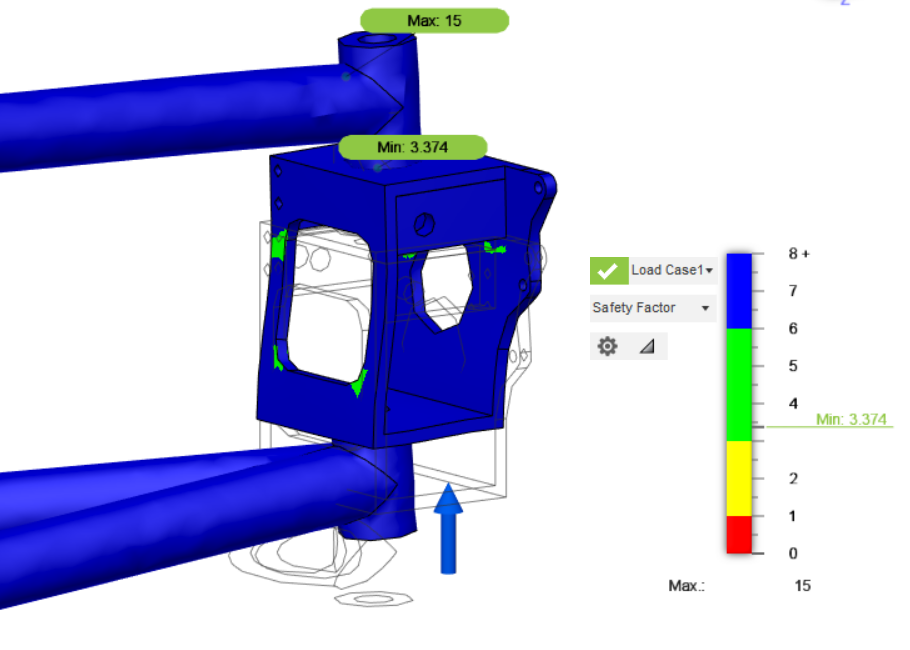
Before I can call the CV bracket redesign complete, I ran the same static stress analysis that I ran previously. The new design's safety factor dropped from mid-threes to 2.99. Officially out of the green zone, i.e. safety factor below 3.

Since the cutout only has to be wide enough to get the CV axle through it, I made the opening more square to increase the wall size at the top and bottom of the bracket. I also added another bolted-in cross-brace at the front of the bracket to increase lateral stiffness. The new safety factor came back 3.37. I think we can call the redesign done, now.

I also posted assembly and mechanical drawings for the front end to the to-do list. These should provide all the info to fabricate the front wheel suspension.


Rudy April 09, 2023
Read more

I bought more aluminum stock. I got heavier tubes for the front wheel support frames, with the thickness determined from the stress simulations I did previously. I also got some 3/4in flat bar for making CNC parts. 

I redesigned the bracket that holds the CV axle to use the 3in x 5in square tube stock that I have. In the previous design, I hoped to fit the CV joint through the space inside the square tube, but the inside width of the square tube isn't wide enough. 

Instead, I will cut a hole on the side wall that is big enough for the CV axle to fit through and mount the CV axle and brake calipers on the opposite wall. I think this design will simplify fabrication of the bracket. No welding is needed and there is less material compared to the last design. 

I'm going to run the same stress analysis that I did for the tubes with this new layout and confirm structural integrity. If the simulations work well, I think we'll be ready to make these. 


I want to make these brackets before welding up the support tubes, so we can use them as a jig during assembly and welding.

Rudy April 03, 2023
Read more