Jabba's line demonstrates his stubbornness of vision. I get that. I have yet to create the picture of the Aluminum Falcon that's in my head. And I don't want to let it go.
The 26" front wheels made the v2 Falcon felt more like a wagon than a dragster. We had to use them to make room for the flotation and to stay above the mud at LKSR, but I didn't like it. To go back to 20" wheels for Falcon v3, we have to be able to raise the front end when we are off-road. This is how we'll do that. 😈
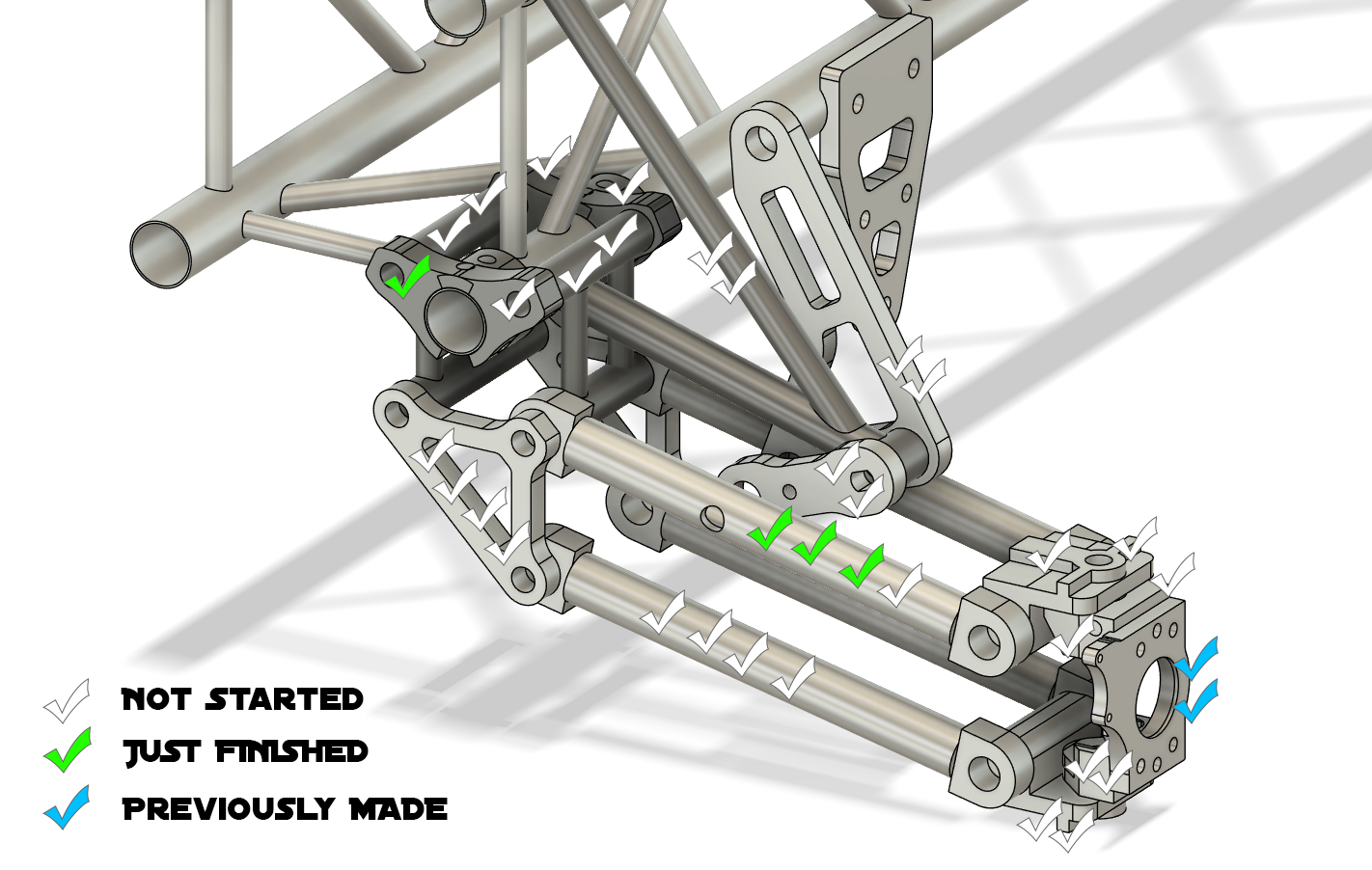
Since the front wheels are connected to each other, the distance between them needs to remain constant. This geometry allows us to lift the front 6 inches and still keep the wheels aligned correctly.
I previously made the wheel bearing plates, but there are MANY more parts to make before I can assemble the new suspension. And I have to make two of everything. Last week, I used the Tormach CNC mill to make one of the four hanger brackets we need.
It took 10 hours to carve that part out of a large block of aluminum! I also fabricated the long tubes and end caps needed to make the 8 steel legs that connect the wheels to the chassis.
While the Tormach was working, I began assembling and welding the legs together.
I was able to finish 3 out of the 8 legs. In total, I made 6 parts. Just another 30 parts to go!
We DID NOT! And incidentally, there was a lot of trying. Our sequel had a lot of the same themes from the year before, but it wasn't quite the same "movie."
We began the race very slowly. And at the back of the pack, but at least we were moving. We followed everyone onto the first obstacle, a cobblestone street called Bone Crusher Alley. We knew the cobblestones were going to be rough, but we only had to make it one long block. At least, that's what we told ourselves going in.
Two-thirds of the way down the Alley, we were stopped by the race stewards. The leader of the race had apparently made a wrong turn, and the rest of us had followed. The traffic jam of slow-moving sculptures brought the whole race to a screech-less halt. We had to turn the Falcon around, but it was designed to move forward.
We executed an awkward k-turn that involved dragging the tires sideways. All the jostling knocked something loose. The front tires cambered out unnaturally. Spokes began to grind against the frame. Then we stopped moving altogether.
I jumped off the Falcon, grabbed a tire and yanked it back into place. I should not have been able to do that. After a few minutes, we realized that the bearings supporting the front wheels had squeezed out of holes like toothpaste. Once the bearings detached, it was all over. Again.
I kept a veneer of a smile on my face. My disappointment was deep. Our race was brief once more. Some have asked me if I'm going to give up on this racer after two poor showings, but, I am not deterred. The Falcon will Return. There is no try.
With the front end rebuilt, we turned to the rear of the sculpture. We had to use the rear wheel at the front, so the back was now wheeless!
That was actually according to plan, but it was late in the game. Our hill test had revealed that the single rear wheel of the Falcon could experience large lateral forces if the sculpture titled sideways. This was a sure way to "taco" the rear wheel.
We determined that using two wheels at the back would significantly reduce that possibility. Although that would technically make the Falcon a four wheeled vehicle, we would keep the wheels close to the frame so that it would still look like a reverse tricycle.
Rebuilding the rear end was easier than the front-end reconstruction, but the wheel hubs we used to build the new rear wheels were different than the front wheel hubs from last year. We originally thought we could use a single bar that supported both ends of each hub. However, the interior of the hubs are tapered. Hollowing them out would've severely weakened them. Instead of using one solid tube across the hub, we created steel inserts that slipped on from either end of the hub.
The inserts were designed to be held in place by the same pins that secure the hubs to the shaft. Since the the hubs tapered before the inserts reached the pin holes, I added that same ~5 degree taper to the inserts 😎.
Water propulsion
Doubling the rear wheels and moving them to the outside of the frame opened up a spot in the back to mount a paddle wheel. We talked through several ideas. We could mount two thin 26 inch bike frames and attach paddles between them. We could also rig up a kind of snow/mud chain to an inflated wheel and attach fins to that. But both those options seemed like they would take too much time to implement—time we didn't have.
Then, Andee came up with a great idea that reused stuff we already had. We would take the now available 20 inch rim and bolt last year's fins onto the end. Adding the fins made the overall diameter 24 inches--well within the 26 diameter of the road wheels.
While I made the inserts, Kreg and Andee assembled the paddle wheel.
Putting it all (back) together
We dry-fit the road wheels and inserts on the shaft, then marked and drilled holes for clevis pins. We also marked and drilled the pin holes for the paddle wheel in the center. Then, we located the drive sprocket on the shaft and cut a keyway there to lock the shaft to the sprocket.
All the pieces of this puzzle were finally ready. With one day until race day, I assembled the new rear end.
Once the base was rolling again, it was a mad dash to complete the rest of the punch list. We had to reconnect the wheels to the Hyperdrive (the sculpture's main drivetrain), rebuild the steering mechanism, rerun the brake lines, make the flotation support mounts, add lights and sound, and, of course pack up the Falcon and load out for the race. There was a lot of smaller things to do, but we still had most of the day left and we had help.
Kevin created a bluetooth sound box!
The combination of 4 switches allowed us to select 16 different tracks from an SD card and played it over a Bluetooth speaker. Kevin, Greg and Andee also added lights to engine area of the Falcon.
Steve worked on the brakes, pedals, and derailleurs.
Andee added skid pads to the raft to protect it from scraping along the pavement.
Andee also attached the rear wheel chain.
We had already reconnected the differential at the front, but because of the new, wider wheelbase, we had to create and install extension bars to bridge the gaps.
I managed to find weld-on adapters online and welded them to custom-length shafts to make the extenders.
The original front drive sprocket on the Hyperdrive was smaller than the rear sprocket. The ratio of the sprockets was the same as the ratio of the wheels. That way, when the sprockets turn, the different-sized wheels would roll the same distance over the same amount of time. This meant that the front wheels needed to spin faster because they were smaller than the larger rear wheel.
With the wheels now all the same diameter, we swapped out the front drive sprocket to be the same size as the rear. Of course, this changed the length of chain needed to complete that loop. We ultimately had to insert another sprocket into the rerouted loop to keep the chain tight.
The last thing we needed to do was drill attachment holes in the poles that connected the main truss to the side pontoons of the raft. This was key to us not sliding off of the raft when we hit the water obstacle.
The sun was already up. It took ALL night, but we actually completed everything we needed to get to the race! We really tried to avoid staying up all night. We're too old to run races on zero sleep. But it was what it was.
We loaded the Falcon onto a rental truck and drove to the start line. It was time to see the Falcon in action.
Two successful road tests. Two successful water tests. But we had a problem. The wheels needed to be lowered 12 inches but we couldn't do that with the current suspension system. The top of the raft that we selected for flotation clears the axle of a 26 inch wheel. Switching from 20 to 26 inch wheels would allow us to mount the raft completely under the truss frame, keeping all the machinery out of the water.
Can I get a lift?
I had just got this bucket together and now I had to make major changes. It took two weeks to come up with a game plan. We were running short on time so reusing most of the existing work at the front end was our first requirement. I first tried to design something closer to a traditional vehicle suspension.
The idea was that we would be able to adjust the ride height during the race. With the start of the race looming, I realized that the idea was too complex to accomplish in the time we had left. We decided instead to keep the suspension static, but relocate the axle and differential below the truss frame. We designed the idea around a steel box beam that would support the main truss. We also added ledges just below the axle for the pontoons, but also for more structural support.
Using the 26 inch wheels also required us to widen the wheelbase by 12 inches. The larger wheels interfered with pedaling while turning, so they had to be moved out for clearance. We decided to make it out of steel, because it's faster (and easier) to weld--but it's sooo heavy. Some quick stress analysis confirmed the basics of the idea.
We got to work fabricating. Caroline and I welded all the U-shaped legs onto the the box beam. Then we welded together the lower knuckle support brackets and pontoon ledges.
\
I used the original knuckles to position all the pieces for welding.
After painting it, I mount new front end.
Wheels on the Falcon go round and round
Switching to new wheels also required modifying new bicycle hubs. Clevis pin holes had to be precisely placed to work with the existing CV axles. However, we discovered that they were too thin to completely hollow out. Instead, we only hollowed out one side then turned down the mounting bolts to fit the hub's existing diameter. It required some creative holding to lock it down, but it worked great.
I handed off the hubs to Steve who then rebuilt the 26 inch front wheels in Lowell Makes' Bike Shop.
While Steve worked on those, I rerouted and reattached the chain from the Hyperdrive to the differential.
Once Steve was done with the wheels, I mounted them onto the Falcon!
Now we just have to reattach the steering linkages to the front wheels. To upgrade the front end, we had and take the wheel from the rear end, because of course! This sounds worse than it is, since we were already rebuilding the rear end.
This task is not as involved as the front end, but there is still work to do back there. Time marches on.
While I'm nose down redesigning the front end because of reasons, Andee and Kreg have been spearheading the canopy upgrades. First, I had to cut the the support tubes in half, to lengthen the entire canopy by 14 inches. I also added some structural improvements to stop the mandibles, cockpit, and escape pods from slouching .
Andee and Kreg then trimmed out all the unfinished areas of the canopy.
Then Andee, Castro, and Dusty painted the upgrades.
We are also working on adding main engine lights.
Race day is fast approaching. There is still much to do. We are making progress, but Time is a harsh mistress.




.png)



